Abstract — The approach to home automation
system design is almost standardized nowadays. In this paper, we tried to
increase these standards by combining new design techniques to home automation
systems. These techniques include controlling the house by means of internet,
GSM cellular communication network and also human voice. Our design integrates
all these methods within a single system in which the user can change the way he/she controls the whole system anytime. Our system
offers a powerful but yet a user-friendly way of real-time monitoring and remote
controlling of the house.
Index Terms — Home
automation, speech recognition, cell phone, internet, real-time monitoring and
remote controlling, RF Communication.
I.
INTRODUCTION
Home automation systems are a result of an attempt to enhance the
standards of living around and inside the house and were made possible by the
breakthrough in the area of integrated circuits and microprocessors. These
systems provide the consumers with increased security and safety, economic
benefit through energy control, and convenience by giving them control over
every piece of domestic electrical equipment in the house. [1]
Designing a home automation system for monitoring and controlling
various devices in remote locations can be done through a variety of
communications options such as wireless LAN technologies, dial-up modems,
private radio networks, satellite communication, internet, cellular network and
so on. Different studies on home automation work on different types of these
controlling methods.
In our model we proposed three
remote controlling methods which are via 1-)
GSM Network 2-) World Wide
Web 3-) Speech . The first two of these
methods are for the users when they are outside the house whereas the third one
is for the users when they are inside the house.
Turkey is a rapidly developing
country in terms of technology and nearly everyone has a personal mobile phone.
Since the first step of the home automation is real-time monitoring of the
status changes of the devices that we control in the house, the system that we
design should have the capability of warning the users no matter where they are
right
at the time at which the changes occur.
Thus, our main objective for using GSM(Global System for Mobile Communication)
network for the communication between the home and the users(and vice versa) is
its wide spread coverage which makes the whole system online for almost all the
time.[2] Other advantages of using GSM systems in home automation are its low
cost compared to other mobile communication methods (such as satellite
communication) , and that it has a very
high security infrastructure so the information we sent or receive can not be
reached by an outsider. Although using GSM network has all these important
advantages over other communication methods, it would be a tedious, time and
money consuming work for the user to use his mobile phone each time he needs to
communicate with the system when we think of the indoor life. To make
indoor-communication (which means the communication with the system when the user
is in the house) easier we suggested another method which uses the voice of the
user’s own to control the whole system. By using the relevant software and
hardware, which will be briefly explained later on this paper, in our model of
home automation system, the user can interact with the system by giving the
commands via his/her speech. This method provides us savings on both time and
money, and greatly simplifies the procedure when the user is at home.
II. SYSTEM OVERVIEW
The system is modeled with three different parts
in Fig. 1.
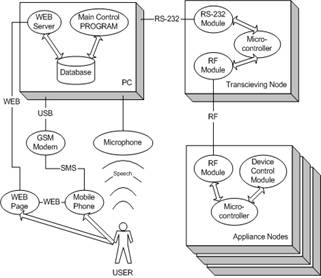
Figure 1 –
Block diagram of overall system
III. COMMUNICATION METHODS
A.
World Wide Web
B.
GSM Network
C.
Speech
IV. SYSTEM ELEMENTS
A.
PC
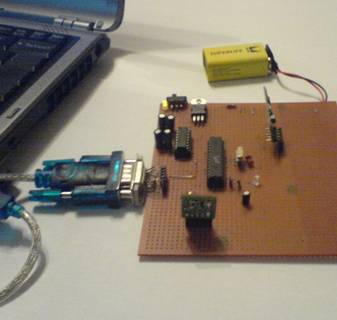
Figure 6 – Transceiving node implementation
C. Appliance Nodes
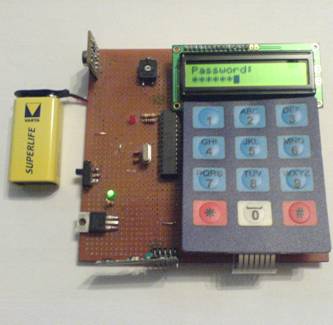
Figure 7
- Main door lock implementation
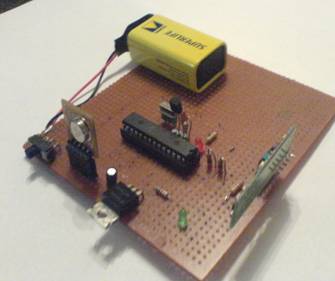
Figure 8
– Temperature sensor implementation
V. CONCLUSIONS
AND FUTURE WORK
This document presentes a speech and mobile controlled and user friendly approach
to the available home automation systems. It is real-time monitorable and
remote controllable which simplifies the users’ indoor life and their
interaction with home. This system can easily be implemented because of its
innecessity to wiring between the appliances since it uses wireless
communication standards.[7] Another
enhancement of the system is its high security. PC controls every data bit by
bit which results in preventing the disorder between different home appliances.
Up to now, firstly we have researched the literatures for all the topics
that include home automation design and wireless networks. Afterwards, we have
built the main control program, web (home) server, a user friendly web page
(still being constructed), the warning system via GSM network (with SMS),
started to establish the RF communication among the appliances, analyzed all
the speech recognition algorithms[3, 8, 9, 10, 11] and chosen the most
appropriate ones (Baum-Welch for training part and Viterbi for recognition
part) for our speech recognition engine. We have also started to implement
these algorithms. All the necessary hardware is designed and half of it is
already implemented.
In the near future, we will try to fully implement the speech
recognition software, build the motion sensor node and integrate a camera with
the main control program for higher security in the house. We will also
implement a user friendly interface on the mobile phone which will enable the
user to communicate with the automation system.
REFERENCES
- C. Douligeris, J. Khawand, C.
Khawand, “Communications and Control for a Home Automation System”
- A. Alheraish ;
“Design and Implementation of Home Automation System”
- L. Rabiner, “A tutorial on Hidden
Markov Models and selected applications in speech recognition” Proc. IEEE,
vol. 77, pp. 257-286, Feb.1989
- Magdi A. Mohamed, Paul Gader,
“Generalized Hidden Markov Models” , IEEE , Transactions on Fuzzy systems,
vol. 8, no. 1, Feb. 2000
- Lawrence Rabiner, Biing-Hwang
Juang “Fundamentals of speech recognition”
- Ali Ziya Alkar and Umit
Buhur; “An Internet Based Wireless
Home Automation System for Multifunctional Devices” , IEEE Transactions on
Consumer Electronics, Vol. 51, No. 4, NOVEMBER 2005
- A. R. Al-Ali and M. AL-Rousan ,
“Java-Based Home Automation System” , IEEE Transactions on Consumer
Electronics, Vol. 50, No. 2, MAY 2004
- Pedro J. Moreno, Bhiksha Raj,
Richard M. Stern, “Data-driven environmental compensation for speech
recognition: A unified approach”
- Xin-yi Zhang, Jin-pei Wu, Qi-shan
Zhang, “An improved speech recognition algorithm based on difference
subspace”
- Kenan Carki, Petra Geutner, Tanja
Schultz, “Turkish Lvcsr: Towards Better Speech Recognition For
Agglutinative Languages “
- L. Gillick, S.J. Coz, “Some Statistical Issues In
The Comparison Of Speech Recognition Algorithms”
 Baris
Yuksekkaya is a senior B.S.
student in Electrical & Electronics Engineering Department, Hacettepe
University, Ankara, Turkey. Completed his high school education in Birikim High
School, Sanliurfa, Turkey in 2002. His main interests are signal processing,
telecommunication systems and high-level language programming. He has
experiences in speech recognition algorithms, and MATLAB. He is a member
of IEEE and secretary of the IEEE student branch of Hacettepe University.
Baris
Yuksekkaya is a senior B.S.
student in Electrical & Electronics Engineering Department, Hacettepe
University, Ankara, Turkey. Completed his high school education in Birikim High
School, Sanliurfa, Turkey in 2002. His main interests are signal processing,
telecommunication systems and high-level language programming. He has
experiences in speech recognition algorithms, and MATLAB. He is a member
of IEEE and secretary of the IEEE student branch of Hacettepe University.
Ali
Alper Kayalar is a senior
B.S. student in Electrical & Electronics Engineering Department, Hacettepe
University, Ankara, Turkey. Completed his high school education in Yenimahalle
Ataturk Anatolian High School, Ankara, Turkey in 2002. His main interests are
high-level language programming, embedded system design, and automation. He has
experiences in ABAP programming language in SAP Platform. He is a member of IEEE and chair of the IEEE student branch of Hacettepe University.
Mehmet Bilgehan Tosun is a senior
B.S. student in Electrical & Electronics Engineering Department, Hacettepe
University, Ankara, Turkey. He is graduated from
Ataturk High School in Ankara, Turkey (in 2002). He is mainly working on
robotics and hardware designing & implementation. He is a member of IEEE and
treasurer of the IEEE student branch of
Hacettepe University.
Murat
Kaan Ozcan is graduated from
Cankaya Milli Piyango Anatolian High School, Ankara, Turkey, in 2002. He is
currently a senior B.S. student in Electrical & Electronics Engineering
Department, Hacettepe University, Ankara, Turkey. He has several work
experiences in different companies. He is mainly interested in wireless
communication technologies and GSM network. He is a member of IEEE
Communications Society and vice chair of the
IEEE student branch of Hacettepe University.