Haber
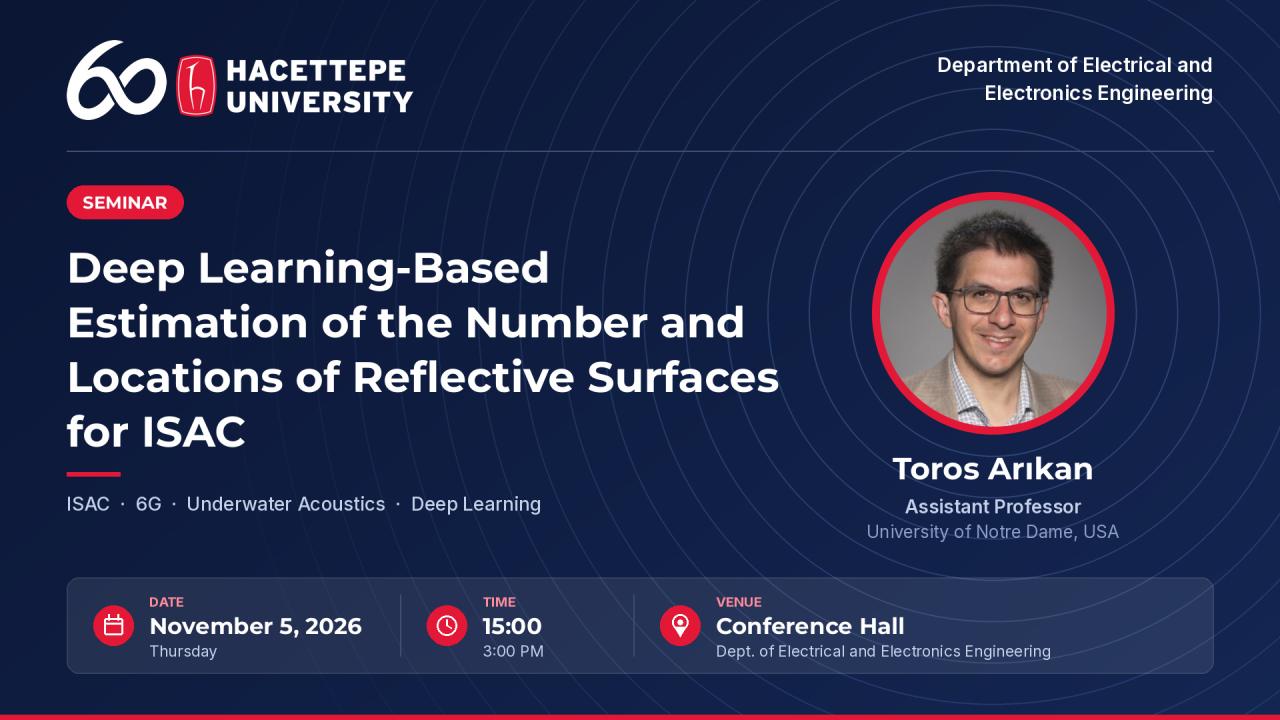
SEMİNER: Deep Learning-Based Estimation of the Number and Locations of Reflective Surfaces for ISAC, Dr. Toros Arıkan, Uni. Notre Dame (ABD), 5 Kasım 2026 Perşembe, 15:00
24 Ekim 2026
Hacettepe Üniversitesi Elektrik ve Elektronik Mühendisliği Bölümü tarafından düzenlenen Bölüm Seminerleri kapsamında University of Notre Dame öğretim üyesi Dr. Toros Arıkan, "Deep Learning-Based Estimation of the Number and Locations of Reflective Surfaces for ISAC" başlıklı bir seminer verecek.
Tüm ilgilenenleri seminerimize davet ederiz.
İNGİLİZCE ÖZET
The integrated sensing and communications (ISAC) framework for sixth-generation (6G) communications is applicable to the underwater acoustic domain, but with fundamental challenges that need to be overcome. The initialization of ISAC pipelines requires the robust single-snapshot estimation of the number of reflective boundaries in the environment, their positions, and a solution to the echo labeling problem for non-line of sight (NLOS) reflections. Once such an initial estimate is obtained, a variety of global optimization methods may be applied to solve the ISAC task; and the better the initial estimate, the more accurate and computationally efficient such an optimization becomes. Current estimation methods require high signal-to-noise ratios (SNRs) and cannot deliver simultaneous estimates of the number of boundaries along with their positions. The key theoretical difficulty to be overcome is the fundamental nonlinear thresholding behavior of time delay estimation (TDE). In this talk, we advance a single-snapshot deep learning method for two-dimensional mapping which outperforms the state-of-the-art and demonstrates strong joint estimation results. Via more advanced neural network (NN) and TDE techniques, we design a U-Net method for long-range shallow water environments and for indoor UWB signaling that is employable for ISAC, which can estimate the number and positions of up to four boundaries in the environment. A key advantage is the circumvention of the combinatorially-difficult echo labeling problem that is complicated at lower SNRs. Future work will extend the proposed method to multiple-snapshot tracking for time-varying environments with mismatched speeds of sound, which is a key feature of long-range underwater communication problems, with applications for environmental monitoring.
KONUŞMACININ BİYOGRAFİSİ
Toros Arikan was born in Mount Kisco, NY, USA, in 1993. He obtained his B.S. and M.S. degrees from the University of Illinois at Urbana-Champaign, with a focus on digital communications and signal processing; and his Ph.D. degree from the Massachusetts Institute of Technology in 2023, specializing in localization, tracking, and remote sensing. In 2023-25 he was a postdoctoral researcher at Rice University, where he researched deep learning methods for environment estimation, and robotic path planning algorithms for cluttered environments. He is currently a new assistant professor in EE at the University of Notre Dame, where he introduced Array Signal Processing as a graduate class, and is pursuing research opportunities in integrated sensing and communications (ISAC) in terrestrial and underwater domains.
Seminer Tarihi: 5 Kasım 2026 Perşembe
Seminer Saati: 15:00
Seminer Yeri: HÜ EEMB Konferans Salonu
İNGİLİZCE ÖZET
The integrated sensing and communications (ISAC) framework for sixth-generation (6G) communications is applicable to the underwater acoustic domain, but with fundamental challenges that need to be overcome. The initialization of ISAC pipelines requires the robust single-snapshot estimation of the number of reflective boundaries in the environment, their positions, and a solution to the echo labeling problem for non-line of sight (NLOS) reflections. Once such an initial estimate is obtained, a variety of global optimization methods may be applied to solve the ISAC task; and the better the initial estimate, the more accurate and computationally efficient such an optimization becomes. Current estimation methods require high signal-to-noise ratios (SNRs) and cannot deliver simultaneous estimates of the number of boundaries along with their positions. The key theoretical difficulty to be overcome is the fundamental nonlinear thresholding behavior of time delay estimation (TDE). In this talk, we advance a single-snapshot deep learning method for two-dimensional mapping which outperforms the state-of-the-art and demonstrates strong joint estimation results. Via more advanced neural network (NN) and TDE techniques, we design a U-Net method for long-range shallow water environments and for indoor UWB signaling that is employable for ISAC, which can estimate the number and positions of up to four boundaries in the environment. A key advantage is the circumvention of the combinatorially-difficult echo labeling problem that is complicated at lower SNRs. Future work will extend the proposed method to multiple-snapshot tracking for time-varying environments with mismatched speeds of sound, which is a key feature of long-range underwater communication problems, with applications for environmental monitoring.
KONUŞMACININ BİYOGRAFİSİ
Toros Arikan was born in Mount Kisco, NY, USA, in 1993. He obtained his B.S. and M.S. degrees from the University of Illinois at Urbana-Champaign, with a focus on digital communications and signal processing; and his Ph.D. degree from the Massachusetts Institute of Technology in 2023, specializing in localization, tracking, and remote sensing. In 2023-25 he was a postdoctoral researcher at Rice University, where he researched deep learning methods for environment estimation, and robotic path planning algorithms for cluttered environments. He is currently a new assistant professor in EE at the University of Notre Dame, where he introduced Array Signal Processing as a graduate class, and is pursuing research opportunities in integrated sensing and communications (ISAC) in terrestrial and underwater domains.
Diğer haberler